

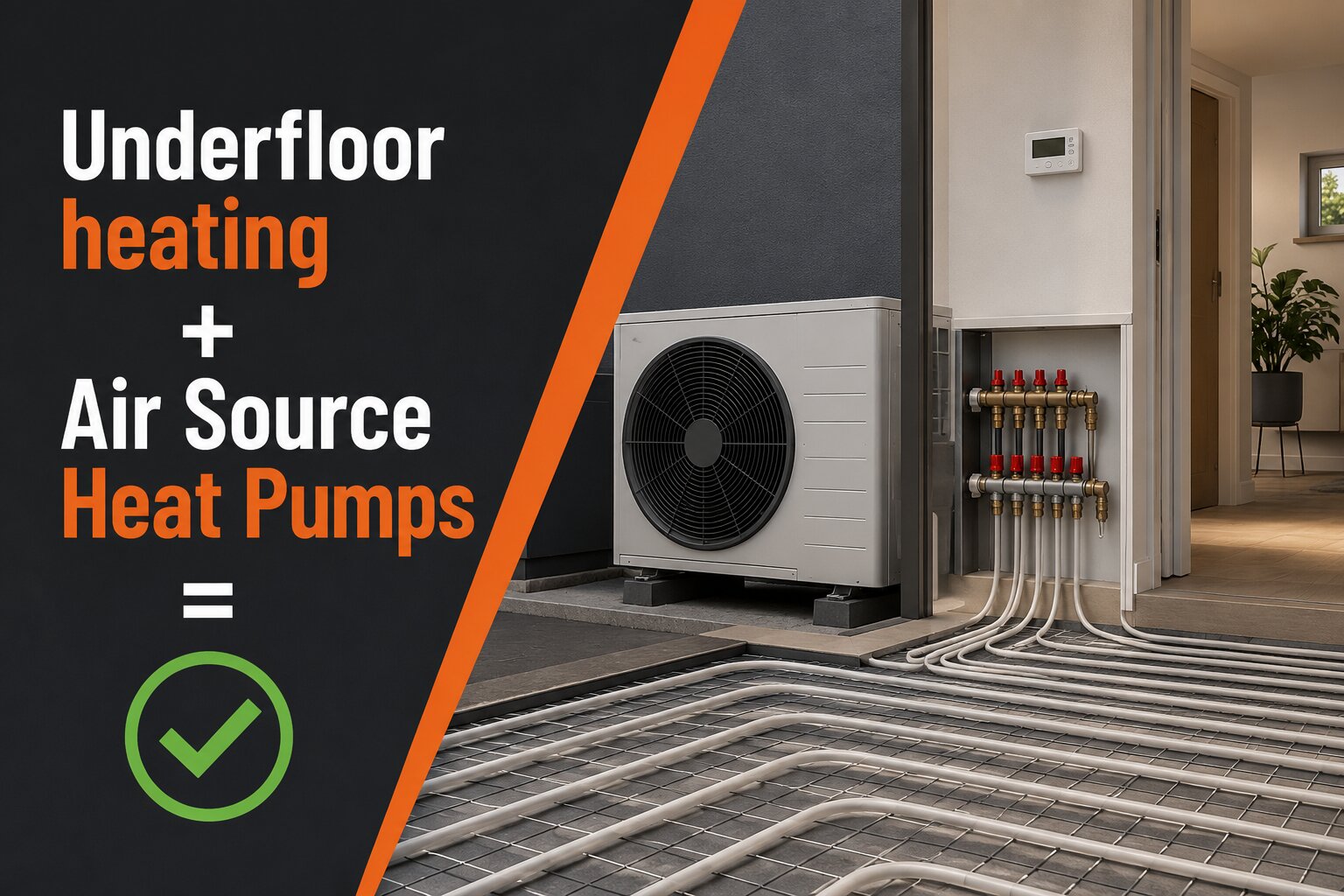

Underfloor heating and air source heat pumps are genuinely one of the best heating combinations available for UK homes. Heat pumps run most efficiently at low flow temperatures (35–45°C), and underfloor heating is specifically designed to work at exactly those temperatures — meaning higher efficiency, lower running costs, and a more comfortable home.
There’s a question we get asked all the time: “Can I use an air source heat pump with underfloor heating?”
The short answer is yes — enthusiastically, yes. The longer answer is that it’s not just compatible; it’s arguably the best pairing in modern home heating. No, you don’t need to live in a glass cube in the Alps to make it work. Most UK homes can benefit from this setup, whether you’re building from scratch or tackling a renovation.
Here’s what you actually need to know.
The quick answer: yes, underfloor heating and an air source heat pump system work brilliantly together
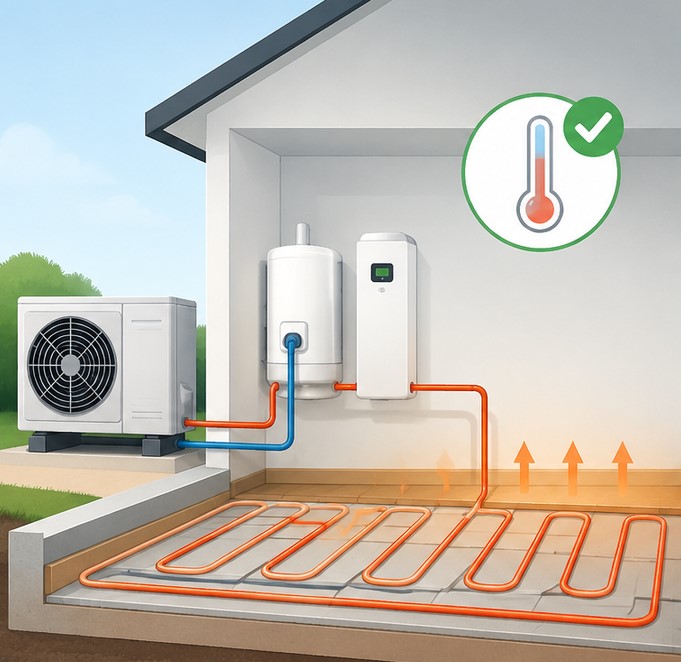
Underfloor heating ASHP systems work so well because of one core principle: flow temperature. Heat pumps are most energy efficient when they’re producing water at lower temperatures — typically 35–45°C. Underfloor heating is specifically designed for exactly that range. It uses the large surface area of your floor to radiate gentle, even warmth without needing high-temperature water.
Traditional radiators, by contrast, often need hot water at 60–75°C to heat a room effectively. Forcing a heat pump to reach those temperatures significantly reduces its efficiency. Every 5°C increase in flow temperature drops the Coefficient of Performance (COP) by roughly 0.3–0.4 — which translates directly into higher running costs.
UFH keeps flow temperatures low. Low flow temperatures keep efficiency high. That’s the pairing in a nutshell.
Why heat pumps love low temperatures
COP is the key number. It measures how much heat a heat pump produces for every unit of electricity it consumes. A COP of 3.5 means 1kWh of electricity generates 3.5kWh of heat — roughly 350% efficiency.
Here’s what that looks like practically, at a typical outdoor temperature of 7°C (according to 2026 industry data from UnderfloorHeating.info):
| Flow temperature | Typical COP |
| 35°C (ideal UFH) | 3.8 |
| 40°C (standard UFH) | 3.4 |
| 45°C (higher UFH) | 3.0 |
| 60°C (old radiators) | 2.0 |
At 35°C, you’re getting roughly twice the efficiency compared to running the same pump at 60°C. That’s a significant difference when you’re looking at annual energy bills.
Why heat pumps and underfloor heating are such a good match
It’s not just about flow temperatures. When you install underfloor heating it works differently from radiators in ways that complement how heat pumps like to operate:
- Large surface area means heat radiates gently across the whole floor, rather than blasting from a single panel
- Even temperature distribution — no cold corners, no standing next to the radiator in a jumper
- Lower air temperature needed — because the heat comes from below, rooms often feel warmer at lower thermostat settings
- Quiet, steady operation — heat pumps run best when ticking along consistently, which suits the slow-response nature of UFH perfectly
The result? Consistent warmth, lower flow temperatures, energy efficiency and a system that runs without constant on and off cycling.
New build vs retrofit: what changes in the real world?
New builds are the easier starting point. Insulation can be designed in from the start, pipework can be embedded in screed before floors go down, and the system can be sized precisely without compromise, which is why installation is generally easier during new construction or major renovations. If you’re building, there’s really no good reason not to spec UFH + ASHP from day one.
Retrofits in an existing property are more involved, but far from impossible. The key questions are: how much floor height can you afford to lose? Low-profile retrofit systems can add only 15–20mm to floor height. Is there adequate insulation beneath the existing floor? We often recommend a hybrid emitter approach for retrofits — underfloor heating on the ground floor (where build-up is easier to manage), with appropriately sized low-temperature radiators upstairs. It’s a practical compromise that still lets the heat pump run at sensible flow temperatures throughout.
System design: the bits that make or break performance
This is where we’d gently suggest not cutting corners. An ASHP + UFH system is only as good as its design — and a poorly designed system will underperform regardless of how premium the equipment is, because even the best heat pump system still depends on insulation and correct design to reach optimal efficiency.
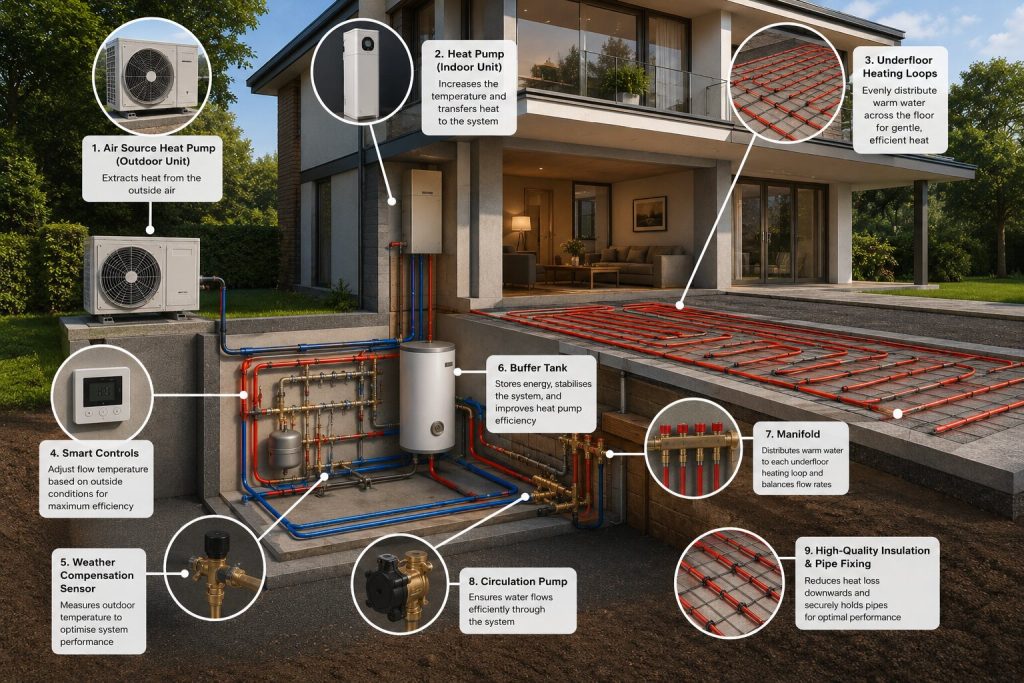
When we design systems at Lloyd’s Gas & Renewables, we focus on:
- Room-by-room heat loss calculations — not a rough estimate, but a properly considered assessment of each space. This is essential for correct sizing and is a requirement for the government’s Boiler Upgrade Scheme (BUS) grant; heat pump systems also perform best in well-insulated homes, so insulation upgrades may be needed before or alongside installation
- Pipe spacing and loop design — closer spacing (150–200mm centres) keeps flow temperatures lower and improves efficiency meaningfully
- Emitter sizing and flow rates — every component needs to be matched to the load it serves
- Commissioning and fine-tuning — a system that’s been properly commissioned and balanced will outperform one that was simply “fitted and left”
- Weather compensation controls — adjusting flow temperature based on outdoor conditions can improve efficiency by 10–15% alone
As Heat Geek-trained installers, we use specialist design software to model performance before a single pipe goes in the ground. Our guaranteed COP from the design process gives customers a clear expectation — and in practice, many of our installations exceed it. One customer shared on Trustpilot that their guaranteed COP was 3.8, but after a full year of operation, they’d achieved an actual COP of 4.8. When designed well, the pairing can be up to 40% more efficient than traditional heating systems.
Running costs and efficiency: what to expect
Running costs vary — there’s no honest way around that. Your insulation levels, how you use the system, your electricity tariff, your flow temperature setpoint, and even your local weather all play a role. Lower flow temperatures also improve heat pump efficiency and reduce overall energy consumption compared with conventional heating systems.
What we can say with confidence:
- A well-designed ASHP + UFH system in a well-insulated UK home will typically achieve a Seasonal Performance Factor (SPF) of 3.0–3.3
- ASHPs are capable of performing effectively in very cold conditions — down to -20°C — so British winters aren’t the problem they’re sometimes made out to be
- Pairing a heat pump with a smart time-of-use electricity tariff (such as those available through OVO Energy, who partner with Heat Geek) can significantly reduce heat pump running costs further
A well-set-up heat pump can reduce energy consumption by around 10–15% versus traditional systems. Underfloor heating can also reduce energy consumption by around 10–15%, and together the pairing can help lower a home’s carbon footprint.
The best thing you can do before worrying about bills is get the design right. A heat pump that’s been properly sized and tuned for low flow temperatures will reward you. One that hasn’t, won’t.
Common mistakes we see (and how to avoid them)
- Running UFH like a boiler system — blasting it on high in the morning and off at night. Heat pumps prefer a steady, lower temperature running for longer periods. Use a “set-back” approach rather than a full off
- No insulation beneath the UFH — without adequate insulation under the pipes, heat travels downward, not into the room. At least 100mm of rigid insulation beneath is the standard recommendation
- Skipping the heat loss survey — “rule of thumb” sizing leads to over- or under-sized equipment. Both are expensive problems
- Ignoring response time — screeded UFH floors have thermal mass. They take longer to warm up than radiators, and longer to cool down. Build that into how you set your controls
Is underfloor heating always the best option with an ASHP?
Genuinely, it depends. UFH is often ideal, but it’s not mandatory. Properly sized low-temperature radiators can also work well with a heat pump — particularly in retrofits where installing UFH would be disruptive or expensive. Fan coil units and fan convectors are another option in some settings.
The point is that there are multiple ways to make a heat pump work efficiently. UFH is frequently the most elegant solution, but the goal is always the same: keep the flow temperature as low as possible. We’ll always assess your specific property before recommending an approach.
FAQs
Can I use an air source heat pump with underfloor heating systems in the UK?
Yes — this is one of the most efficient heating combinations available. Heat pumps operate most efficiently at the low flow temperatures (35–45°C) that underfloor heating is designed for, making them a natural pairing.
What flow temperature does underfloor heating typically need?
Well-designed UFH systems can run at 35–40°C in well-insulated homes, or 40–45°C in average UK properties. This is significantly lower than radiator systems, which is why efficiency is higher.
Will UFH work upstairs as well as downstairs?
It can, though upstairs installation in retrofits often involves more disruption. Many retrofit projects use UFH downstairs and upgraded low-temperature radiators upstairs — a practical hybrid approach.
Is underfloor heating expensive to run with a heat pump?
When the system is well-designed, running costs are competitive. Key factors include insulation quality, flow temperature, electricity tariff, and how the controls are set. A good heat loss survey and proper commissioning are the best investments you can make.
Do I need a buffer tank with ASHP underfloor heating?
Not always. Whether a buffer or hydraulic separation is needed depends on the specific system design and heat pump model. We assess this on a case-by-case basis — it’s not a one-size-fits-all answer.
How long does UFH take to warm up?
Screeded UFH floors typically take 2–4 hours to reach operating temperature, compared to 30–60 minutes for radiators. However, UFH also retains heat longer — so the system doesn’t need to work as hard once it’s up to temperature. Running it steadily (rather than cycling on and off) suits both UFH and heat pumps.
How do I know if my home is suitable for ASHP underfloor heating UK installations?
A room-by-room heat loss survey is the only reliable way to find out. It’ll tell you what flow temperature you need, whether your insulation is adequate, and what system design will work best for your home.
Getting the comfort (and savings) you’re paying for
The underfloor heating and air source heat pump combination delivers on its promise — but only when it’s designed and installed properly. The technology isn’t the variable. The installer’s depth of knowledge, the accuracy of the heat loss survey, the care taken with pipe spacing and commissioning: that’s what separates a system that performs brilliantly from one that just about gets by.
At Lloyd’s Gas & Renewables, we’re Heat Geek-trained installers with over 100 five-star Trustpilot reviews and a genuine focus on getting system design right — not just fitting equipment. We carry out detailed heat loss surveys for every project, design every system around your specific home, and don’t leave until it’s running as it should.
If you’re considering underfloor heating with an air source heat pump — whether for a new build, a renovation, or a retrofit — we’d love to have a chat. Get in touch with our team or use our fast, free estimate tool to get started.