


Somewhere along the way, a rumour started that heat pumps simply don’t work in British homes—too old, too draughty, too used to a boiler blasting them into submission every winter. It’s not true, but like most myths, there’s a grain of truth buried in there. A heat pump can absolutely keep a Manchester home warm through the depths of January. But how well it does that job, and how much it costs to run, comes down to one thing more than any other: how well your home holds onto the heat it’s given.
Think of it this way. A heat pump doesn’t create fierce, instant heat like a gas boiler does. It works more gently, producing a steady, lower-temperature warmth over a longer period. If your home is leaking heat out through the loft, walls and windows faster than the heat pump can replace it, you’re essentially trying to fill a bath with the plug out. It’ll still get warm eventually—but you’ll be paying for a lot of wasted energy along the way.
This guide explains exactly how insulation and home energy efficiency affect heat pump performance, what “good enough” insulation actually looks like, and what to prioritise if your home needs a bit of help before (or after) installation. We’ve installed enough systems across Greater Manchester to know that every house is different, and the right answer for your neighbour’s semi might not be right for yours.
The simple physics: heat pumps hate wasting heat
Here’s the easiest way to picture it. Insulation is the jumper, and the heat pump is the kettle. If you’re wearing a jumper, the kettle only needs to top up the warmth your body’s already holding onto. Take the jumper off in a cold room, and that same kettle has to work flat out just to stop you shivering.
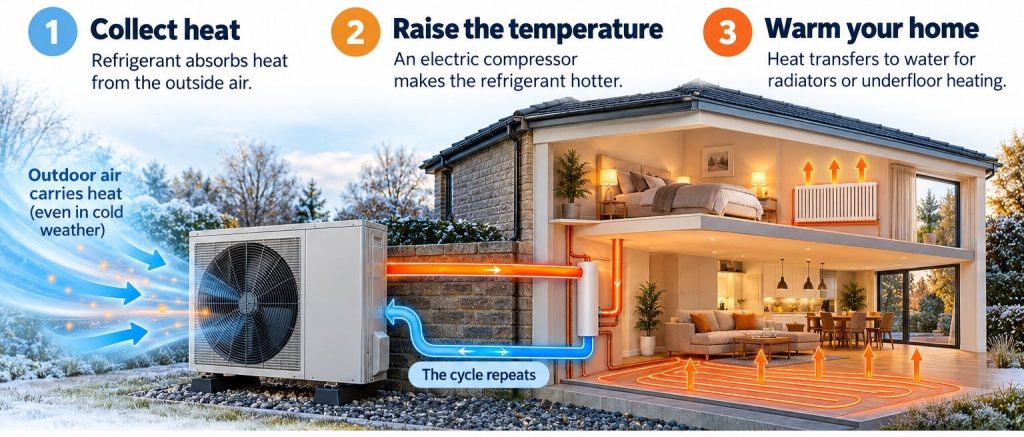
A heat pump extracts heat from the outside air and moves it into your home, producing roughly three to four units of heat for every one unit of electricity it uses. That efficiency is at its best when the system can run steadily at a lower flow temperature. A well-insulated, reasonably airtight home lets it do exactly that. A draughty one forces it to push harder and run for longer, which chips away at efficiency and, in turn, your bills.
None of this means a heat pump won’t work in an older or less efficient property. It just means the system—and the building around it—need to be designed with that in mind.
Do I need to have good insulation for an air source heat pump?
In short, yes, though “good insulation” is more of a sliding scale than a strict entry requirement. You don’t need to live in a Passivhaus to make a heat pump worthwhile. What you do need is a reasonable baseline: a decently insulated loft, minimal draughts, and glazing that isn’t actively letting the cold in.
If your home ticks those boxes, a heat pump should perform well from day one. If it doesn’t, that’s not necessarily a dealbreaker—it just means we’ll design the system (and possibly recommend a few fabric upgrades) to compensate. What we wouldn’t recommend is installing a heat pump into a home that’s losing heat like a sieve and hoping for the best. That’s how people end up disappointed with running costs, through no fault of the technology itself.
The honest answer, and the one you won’t always get from a salesperson in a hurry to close a deal, is that insulation and heat pumps work as a team. Get the fabric of your building right, and the heat pump does its job efficiently, quietly, and affordably.
Will a heat pump work in a cold house?
This is probably the question we’re asked more than any other, usually by someone who’s had a cold, draughty living room for years and quietly assumes it’s a lost cause. The good news: a heat pump will work in a cold house. The real question is whether it’ll do so efficiently, and that depends on why your house is cold in the first place.
If your home suffers from poor insulation, ill-fitting windows, undersized radiators, or all three, a heat pump can still heat it. But it’ll need to be sized and designed correctly to cope with that heat loss, which might mean a larger unit, upgraded radiators, or improved emitters to get warmth into the room at a lower, more efficient flow temperature.
A few signs your home might be “losing the battle” against the cold:
- Rooms that never quite feel warm, even with the heating on for hours
- Condensation on windows or damp patches in corners
- Radiators that are hot at the top and lukewarm lower down
- A noticeable draught around doors, skirting boards, or loft hatches
None of these rule out a heat pump. They just tell us where to focus during the design process. This is exactly why we carry out a full heat loss survey before recommending anything—working out where your home is losing warmth, and building the system around that reality rather than a generic template.
What home efficiency rating do I need for a heat pump?
There’s no official minimum EPC rating you need to have a heat pump fitted, and we’d be wary of anyone who tells you otherwise. Homes rated anywhere from A to G can technically have one installed. That said, your EPC rating is a useful (if slightly blunt) indicator of how efficiently your heat pump is likely to run.
Generally speaking, a home rated C or above will let a heat pump operate at its most efficient, with lower running costs and fewer comfort compromises. Homes rated D or below can still perform well, but they’re more likely to benefit from some fabric improvements first, or a system specifically designed to cope with higher heat loss.
Rather than fixating on a single letter on a certificate, we’d always recommend a proper heat loss survey. An EPC is based on standardised assumptions about your home; a heat loss survey looks at your actual walls, windows, room sizes and current heating setup. It’s a far more accurate way to understand what your home—and your future heat pump—will actually need.
Insulation upgrades that make the biggest difference (and won’t bankrupt you)
If you’re planning a heat pump and suspect your home could do with a bit of help first, you don’t need to remortgage the house to get there. Some upgrades offer far better value than others.
Loft insulation
This is usually the biggest bang for your buck. Heat rises, and an under-insulated loft is one of the quickest ways to lose it. Topping up to the recommended depth is relatively inexpensive and can noticeably reduce heat loss.
Draught-proofing
Cheap, quick, and often overlooked. Gaps around doors, windows, floorboards, and loft hatches let cold air in and warm air straight back out. Sealing them up is a bit like finally noticing you’ve left a window open all winter.
Cavity wall insulation
For homes built with cavity walls (most properties from the 1920s onwards), filling the cavity can make a substantial difference to how well the building retains heat.
Solid wall homes
Older properties with solid walls have fewer easy wins, but internal or external wall insulation can still be worthwhile, particularly if you’re planning other renovation work at the same time.
Floor insulation
Often forgotten, but a genuinely underrated upgrade, especially in homes with suspended timber floors where cold air can circulate underneath.
Windows and doors
Double glazing helps, but it’s not always essential. Secondary glazing or simply improving seals can bring meaningful benefits without the cost of a full window replacement.
If your budget’s tight, start with the loft and draught-proofing. They’re the cheapest fixes and often deliver the most noticeable improvement before you even think about the heat pump itself.
How efficiency changes heat pump sizing and radiator requirements
The less heat your home loses, the smaller and more efficient your heat pump can be. Heat loss (measured in kW) directly determines the size of the system you need. Fit a system that’s too small, and it’ll struggle on the coldest days. Fit one that’s oversized, and you’ll pay more upfront and potentially see it cycling on and off inefficiently.
This is also where radiators come into the conversation. Heat pumps work best when heating water to a lower temperature than a traditional boiler, so smaller or older radiators sometimes need upgrading to release enough warmth into the room. It’s not always the case, but it’s something a proper survey will identify, rather than something you find out the hard way after installation.
This is precisely why we don’t do cookie-cutter installs. Every system we design starts with a full heat loss calculation, room by room, so the sizing, the radiators, and the flow temperatures are all matched to your actual home rather than a rough estimate.
Comfort and running costs: what you’ll notice day-to-day
Homeowners moving from a gas boiler to a heat pump are often surprised by how different the experience feels—in a good way, once they get used to it. Rather than short, intense bursts of heat, a heat pump provides a steady, consistent warmth that’s usually best left running gently rather than switched on and off like a boiler.
In a well-insulated home, that steady warmth holds beautifully, and you’ll notice fewer cold spots and less of the “blast and chill” cycle you might be used to. In a less efficient home, you may notice more temperature fluctuation, particularly in rooms further from the heat source, until any recommended insulation improvements are made.
A few things that tend to catch new heat pump owners off guard:
- The heating running for longer periods, but at a lower, gentler output
- Radiators feeling warm rather than scalding hot to the touch
- Noticeably quieter operation than expected
Quick home efficiency checklist before you commit
Before booking a survey, it’s worth having a quick look round your own home. A few minutes with this checklist can save time later:
- Loft insulation depth (ideally at least 270mm)
- Draughts around doors, windows, and loft hatches
- Any unused chimneys or vents that might be losing heat
- Radiator size and how quickly rooms heat up
- General condition of your windows and glazing
- Space and access for a hot water cylinder, if you don’t already have one
None of this needs to be perfect before you get in touch. It just gives us a head start when we come to survey your home.
Frequently asked questions
Do I need to have good insulation for an air source heat pump?
You need a reasonable baseline—loft insulation, minimal draughts, and decent glazing—but you don’t need a perfectly insulated home. Less efficient homes can still have a heat pump fitted; it just needs to be designed and sized accordingly.
Will a heat pump work in a cold house?
Yes. A heat pump can heat a cold, draughty home, but it’ll need to be sized correctly and may benefit from insulation improvements or radiator upgrades to run efficiently.
What home efficiency rating do I need for a heat pump?
There’s no official minimum EPC rating required. Homes rated C or above tend to see the best efficiency, but a proper heat loss survey is a far more accurate guide than the EPC alone.
Can I get a heat pump if I’ve got solid walls?
Yes. Solid wall homes can absolutely have a heat pump installed. Internal or external wall insulation can help improve efficiency, but it’s not always a prerequisite.
Do I need new radiators for a heat pump?
Sometimes. Heat pumps run at lower flow temperatures than boilers, so some radiators may need to be upgraded to release enough heat into the room. This is identified during your survey.
What’s a heat loss survey and why does it matter?
It’s a room-by-room assessment of how much heat your home loses, used to correctly size your heat pump and identify any radiator or insulation upgrades needed. It’s far more accurate than relying on an EPC alone.
Are heat pumps noisy?
Not really. Modern air source heat pumps are generally quieter than most people expect, comparable to a quiet outdoor fan unit.
Can a heat pump still work in freezing weather?
Yes. Modern systems are designed to operate efficiently even when outside temperatures drop to around -20°C, so a typical UK winter is well within their comfort zone.
Is the £7,500 BUS grant available to me?
Many homeowners are eligible for the Government’s Boiler Upgrade Scheme, which offers £7,500 towards the cost of a heat pump installation. Eligibility criteria apply, and we can talk you through this during your free consultation.
How long does installation take?
This varies depending on the size and complexity of the system, but most residential installations are completed within a few days once the design and survey are finalised.
Ready to find out what your home actually needs?
If you’ve read this far wondering whether your own home is up to the job, the honest answer is: we won’t know for certain until we’ve had a proper look. That’s exactly what our free, no-obligation consultation is for.
We’re MCS accredited and Heat Geek certified installers, covering Manchester and the whole of Greater Manchester. Every system we design starts with a full heat loss survey, not a generic template, and we’re proud members of the APHC, RECC, and IWA, so you’re covered every step of the way. With over 140 five-star Trustpilot reviews, we like to think our customers agree we do things properly.
If you want to know what would genuinely work in your home, whether that’s a straightforward install or a bit of fabric-first groundwork beforehand, get in touch with our team and we’ll happily talk it through.